Cardano founder Charles Hoskinson is building a new programming language for the network
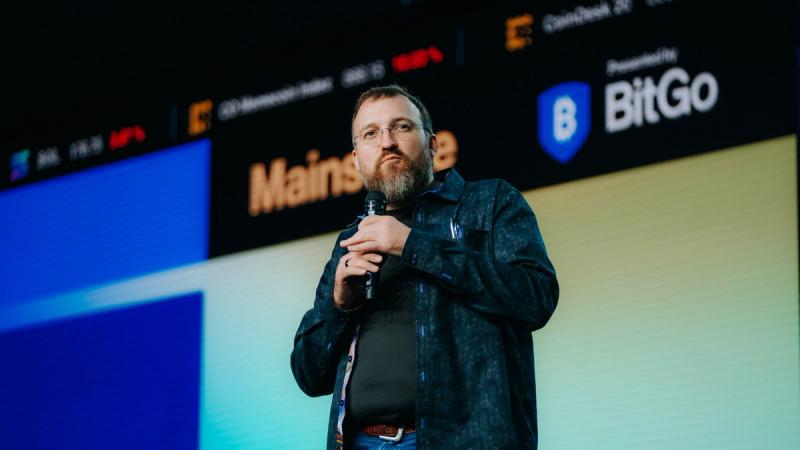
- Cardano founder Charles Hoskinson said he is personally developing a new programming language with Input Output Global engineer Lucas Rosa.
- The language would combine transaction intents, proof-carrying data and Groth16 proofs to help applications execute user requests and efficiently verify that conditions were met.
- Hoskinson has not disclosed the language’s name, released public code or announced when developers will be able to use it.
Cardano founder Charles Hoskinson is writing a new programming language for his blockchain. He says it will be the first to combine what a user wants a transaction to do with cryptographic proof that the rules were followed.
“I’m actually personally developing a programming language for Cardano,” Hoskinson wrote on X on Sunday, adding that he’s working on it with Lucas Rosa, a software engineer at Input Output Global who co-created Aiken, one of Cardano’s main smart contract languages.
That’s not something most founders do once their network is this big. Hoskinson runs a company full of engineers and is still choosing to write the tool future Cardano apps could be built on himself.
The language would support three tools: transaction intents, proof-carrying data and Groth16 proofs.
An intent lets a user say what they want done and leave the steps to the app. A trader could ask to swap one token for another only if the final price meets set conditions, without spelling out how to get there.
Proof-carrying data attaches cryptographic evidence to a piece of information, showing it follows certain rules. Another app can check that evidence without redoing every calculation behind it.
Groth16 is a widely used proof system that produces tiny proofs computers can check quickly. Those proofs can show a condition was met without revealing the private data used to meet it.
Together, they could let developers build apps that coordinate trades, check complicated conditions, and pass verified information between services, with Cardano checking a small proof at the end.
Cardano developers already write smart contracts in Plutus, which is built on the programming language Haskell, and in Aiken. Midnight, the privacy-focused blockchain built by Hoskinson’s company Input Output Global, has its own language, Compact, for apps that handle confidential data.
Meanwhile, Hoskinson hasn’t shared the new language’s name, any public code, or a date when developers can start using it.

- 1Strategy on verge of golden cross, just weeks after bitcoin flashed same bullish signal1 hour ago
- 2Live updates: Bitcoin edges higher as U.S. stocks rebound early Monday2 hours ago
- 3Bitcoin extends bounce above $82,000 as stocks rebound, DeFi tokens lead altcoin gains2 hours ago
- 4JPMorgan's JPM Coin, representing dollar deposits, is coming to Ethereum: Bloomberg3 hours ago
- 5Crypto vault deposits top $10 billion as lending risks draw regulatory scrutiny3 hours ago
- 6Bitcoin mining offshoot Nscale loses Microsoft AI deal as power delay stretches into 2030s3 hours ago
- 7CME’s bitcoin cash, uniswap futures, global PMIs: Crypto Week Ahead4 hours ago
- 8Bitcoin whale moves $34 million in BTC it got in 2013 when coins traded at $1316 hours ago
- 9Zcash developers plan a fix to keep ZEC swaps private from future quantum computers7 hours ago
- 10XRP Ledger is set to fix its lending code before anyone can use it8 hours ago
Beyond the Risk-Free Rate: Diversified Real World Yield in Productive Stablecoins

Beyond the Risk-Free Rate: Diversified Real World Yield in Productive Stablecoins
Diversified RWA stablecoins sustain 5-7% yield from real credit as crypto funding compresses to ~4%. GENIUS pushes yield off-chain; TAM grows to $4B in 3 years.
Diversified RWA stablecoins sustain 5-7% yield from real credit as crypto funding compresses to ~4%. GENIUS pushes yield off-chain; TAM grows to $4B in 3 years.
Why it matters:
Diversified RWA stablecoins sustain 5-7% yield from real credit as crypto funding compresses to ~4%. GENIUS pushes yield off-chain; TAM grows to $4B in 3 years.

Bitcoin mining offshoot Nscale loses Microsoft AI deal as power delay stretches into 2030s

Zcash developers plan a fix to keep ZEC swaps private from future quantum computers

XRP Ledger is set to fix its lending code before anyone can use it
Related stories

Latvia Changes Crypto Tax Treatment And Opens A 2027 Declaration Window
Morning Minute: Crypto Rebounds as 'Black Monday' Looms

Qubic Halts Blockchain After Weak Wallet Seeds Leave 1,400 Accounts Exposed