Here's how much bitcoin and the S&P 500 could rally after midterms
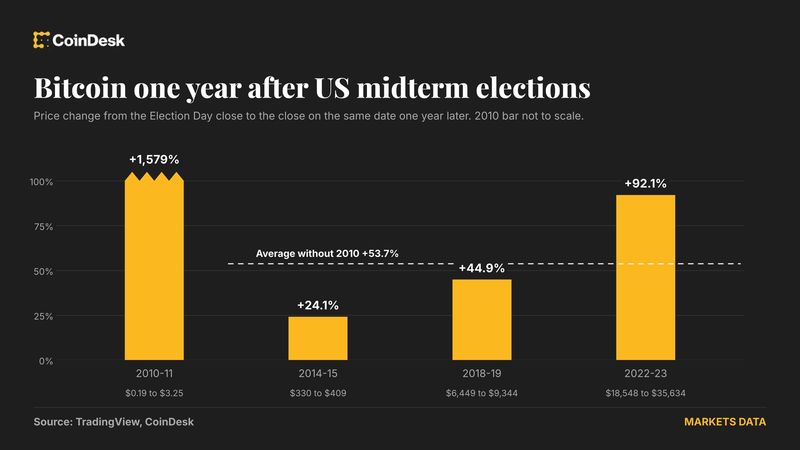
- Bitcoin gained an average of 53.7% in the 12 months after the past three U.S. midterm elections, excluding 2010, though its four-year halving cycle may better explain those rallies.
- The S&P 500 has risen an average of 15.17 percent in the year after midterm elections since 1950, more than double its average gain in other years.
- A Democratic takeover of at least one chamber of Congress could intensify disputes over federal debt, defense spending and President Donald Trump’s crypto ties, although markets have largely priced in divided government.
Both crypto and Wall Street could be in for a strong run after the Nov. 3 U.S. midterm elections, if history is a guide.
Since its inception in 2009, bitcoin BTC$84.459,46, the largest cryptocurrency by market value, has seen four midterms. Leaving out 2010, when the market was tiny and fringe, the other three saw prices for the cryptocurrency rise an average of 53.7% in the 12 months after Election Day, according to data analyzed by CoinDesk. The returns here refer to the percentage rise from the daily close (00:00 UTC) on Election Day to the close on the same date a year later.
Bitcoin surged 1,579% in the 12 months after the 2010 midterm, but the market was fringe and too small then for that figure to be reliable.
If history repeats, bitcoin’s recent subdued price action around $80,000 could pave the way for another leg higher after Nov. 3. BTC has already bounced more than 35% since bottoming out below $60,000 in June. Some analysts believe now is the time to buy and hold crypto, as a new bull run is upon us.
Politics or halving cycle?
Still, history is too limited to draw firm conclusions, and the post-midterm surges in BTC seen over the years may have more to do with the four-year cycle than U.S. politics.
Bitcoin tends to move in cycles of roughly four years, built around the mining reward halving, an inbuilt code in the Bitcoin blockchain that reduces the per block BTC produced and given to miners by 50% every four years.
After each of the four halvings to date, BTC rallied sharply, peaked 12 to 18 months later and then sliding into a bear market. Those bear markets played out in midterm years – 2014, 2018, 2022 and now 2026. So the rebound that followed the midterms may have been a fresh cycle start rather than politics at work.
S&P 500 has a long bullish history
The S&P 500 has a much longer record, and it also points up, a positive sign for bitcoin and other risk assets.
Since 1950, the index has averaged a 15.17% gain in the year after midterms, against 7.30% in all other years, according to Hartford Funds.

What’s at stake this time
The 2026 elections could change how President Donald Trump operates in his final two years in the White House.
If Democrats win one or both chambers of Congress, the politics over the record federal debt may heat up, as the debt limit issue is still unresolved and talks over the same may complicate. Trump’s push for $350 billion in mandatory defense funding may not stand a chance, according to Brookings. Democrats could use legislative hurdles to arrest funding for Middle East escalations.
Newsletter
Speaking of crypto, Democratic committee chairs could investigate conflicts of interest tied to Trump’s personal crypto profits. Democratic lawmakers have already sent oversight letters on the president’s crypto ties and family business ventures. Trump’s memecoin, launched in January 2025, has also led to heavy losses for retail investors.
That said, the Supreme Court’s ruling in Trump v. Slaughter left most financial regulators under White House control, so Congress could do little to stop the administration from promoting crypto.
For now, markets have largely priced in a divided federal government, with Democrats expected to retake at least one chamber of Congress.

- 1Kospi surges 7% as SK Hynix earnings fuel AI stock rebound6 minutes ago
- 2Securitize adds Stellar blockchain as institutional tokenization gathers steam1 hour ago
- 3Bitcoin treasury Datavault AI plunges 50% after firm says it can’t access its BTC4 hours ago
- 4Bithumb hacked through employee system as South Korean financial firms face cyberattacks4 hours ago
- 5Bitcoin nears $81,000 ahead of Fed decision as ZEC jumps 8%5 hours ago
- 6Coinbase says user funds are safe after third-party vendor exposes customer contact info6 hours ago
- 7Treasury's Bessent sees crypto as America's next tool for keeping the U.S. dollar on top13 hours ago
- 8Robinhood's crypto revenue fell 55% from last year, but topped Street forecasts13 hours ago
- 9U.S. agency hits Utah with lawsuit to shield Kalshi's ability to offer betting there14 hours ago
- 10Intel, Oracle, IBM join growing list of firms objecting to OKX–ICE tokenized stock plans15 hours ago
Beyond the Risk-Free Rate: Diversified Real World Yield in Productive Stablecoins

Beyond the Risk-Free Rate: Diversified Real World Yield in Productive Stablecoins
Diversified RWA stablecoins sustain 5-7% yield from real credit as crypto funding compresses to ~4%. GENIUS pushes yield off-chain; TAM grows to $4B in 3 years.
Diversified RWA stablecoins sustain 5-7% yield from real credit as crypto funding compresses to ~4%. GENIUS pushes yield off-chain; TAM grows to $4B in 3 years.
Why it matters:
Diversified RWA stablecoins sustain 5-7% yield from real credit as crypto funding compresses to ~4%. GENIUS pushes yield off-chain; TAM grows to $4B in 3 years.

Kospi surges 7% as SK Hynix earnings fuel AI stock rebound

Bitcoin treasury Datavault AI plunges 50% after firm says it can’t access its BTC

Bitcoin nears $81,000 ahead of Fed decision as ZEC jumps 8%
Kospi surges 7% as SK Hynix earnings fuel AI stock rebound

Securitize adds Stellar blockchain as institutional tokenization gathers steam
Bitcoin treasury Datavault AI plunges 50% after firm says it can’t access its BTC
Related stories

Bitcoin price eyes $82K as Morgan Stanley strategist says most of correction is over

Bitcoin Hovers Around $80,000 as Fed Decision Draws Closer

Bitcoin ETF inflows climb to $176M as BTC rebounds above $80K